

Ask The Expert: What Is 3 On 6 vs All On 4?
If you are looking into restoring your smile, you have likely encountered various terms and treatment names. One of the most common comparisons patients ask us about is the difference between 3 on 6 vs all on 4. Understanding the nuances of these treatments is crucial for making an informed decision about your long-term dental health.
In the video above, Dr. Caleb Stott and Dr. Tyler Tolbert dive deep into these procedures during this “Ask the Expert” segment. We answer real patient questions from the internet to clarify why we often recommend more implants and how specific techniques like the 3 on 6 can offer superior results for eligible patients.
The Philosophy of “More Than Four”
For many years, the standard for full arch dental implants was the All-on-4 procedure. This technique involves placing four implants in the front of the jaw to support a full set of teeth. It was designed to avoid sinuses and nerves, and it has worked well for millions of people. However, looking at the 3 on 6 vs all on 4 debate involves looking at stability and redundancy.
At Smile Now Dentures and Implants, our philosophy is generally “more than four.” While four implants can work, they have limitations. If you only have four implants and one fails to integrate or develops an issue later, the entire prosthesis is compromised. In the industry, we sometimes joke that “all on four” can quickly become “nothing on three” because three implants are rarely enough to support a full arch.
By placing five or six implants, we create an insurance policy for your smile. Adding implants behind the front four spreads the load more evenly and provides better physical support for the bridge. This distribution helps prevent breakage and ensures that if one implant has an issue down the road, the remaining implants can often still support the teeth without requiring a complete restart.
What is the 3 on 6 Dental Implant Treatment?
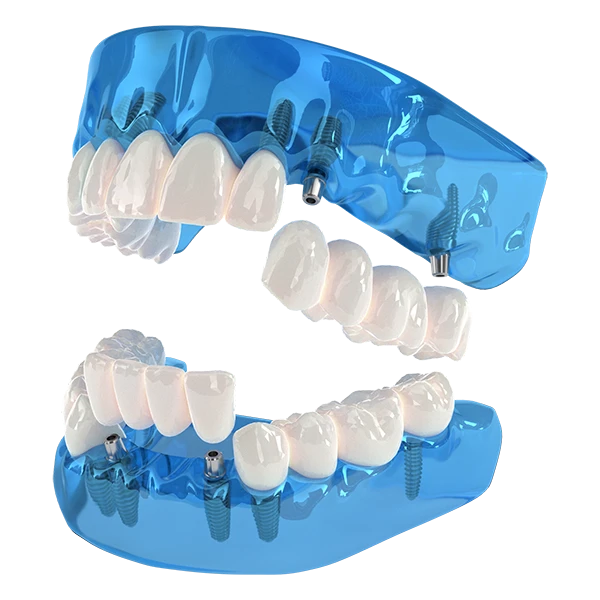
While discussing 3 on 6 vs all on 4, it is important to define what “3 on 6” actually means. It is a specific way of engineering your new smile. Instead of one solid horseshoe of teeth connected to all the implants, the 3 on 6 method uses six implants to support three separate dental bridges.
This means you have three distinct segments of teeth. Each segment is typically supported by two implants. This segmentation offers unique advantages over a single continuous piece.
Advantages of the 3 on 6 Approach
- Increased Strength:
Breaking a short stick is much harder than breaking a long one. By segmenting the arch into three shorter bridges, the overall restoration is often stronger and less brittle than a single long piece. - Easier Repairability:
If you accidentally chip a tooth or damage a bridge, we only need to remove and repair that specific segment. With All-on-4, the entire full arch must be removed for repairs. - Natural Feel and Hygiene:
The 3 on 6 restoration is often an “FP1” prosthesis, meaning it replaces just the teeth and not the gum tissue. This allows you to floss between the segments, making it feel much more like your natural teeth compared to other options.
Comparing the Options: 3 On 6 vs All On 4
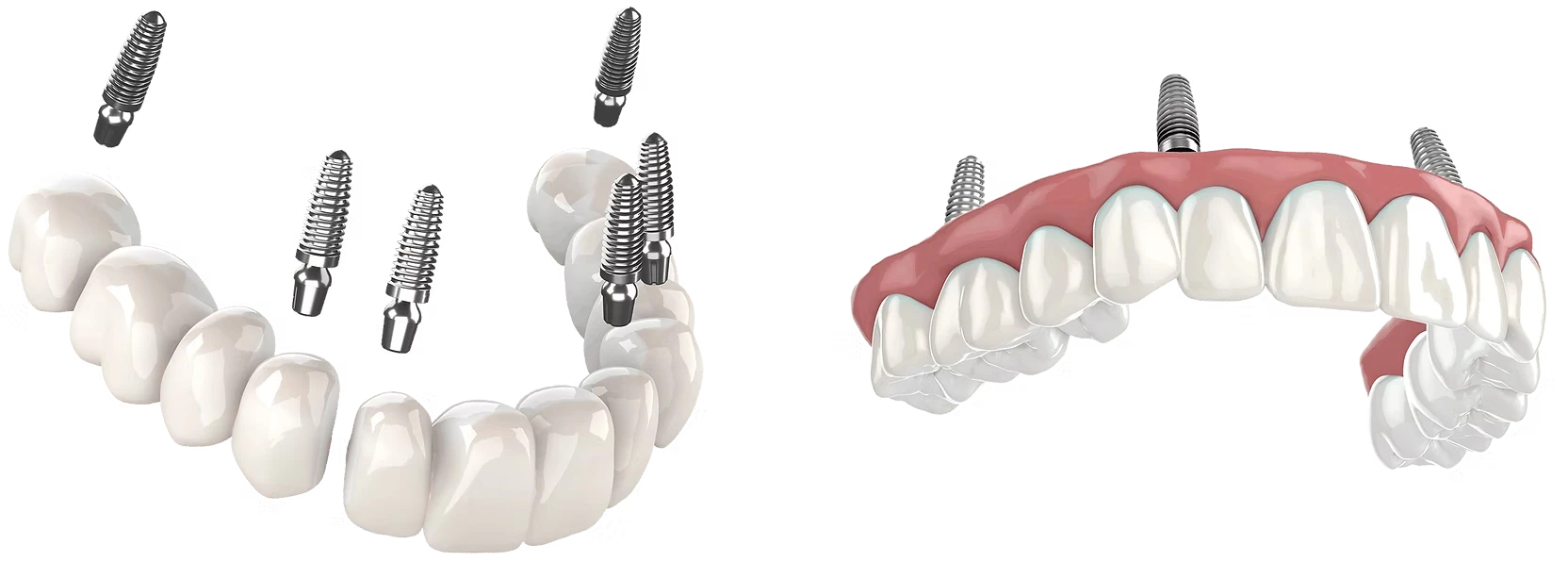
When weighing 3 on 6 vs all on 4, consider how the engineering differences impact your daily life and long-term security.
| Feature | 3 on 6 Implants | All-on-4 Implants |
|---|---|---|
| Implant Count | 6 Implants | 4-6 Implants |
| Prosthesis Design | 3 separate bridges (segmented) | 1 continuous full arch bridge |
| Hygiene | Can floss between segments | Cannot floss between teeth (water flosser required) |
| Bulkiness | Minimal (FP1); resembles natural tooth size | Often requires artificial pink gum for support |
Addressing Common Dental Implant Questions
We often see dental implant questions regarding complications, such as biting cheeks, bulky teeth, or implant failure. These issues often arise when the surgical and restorative aspects of the treatment are handled by different providers who do not work under the same roof.
To avoid the “two quarterbacks” problem, where a surgeon and a dentist might blame each other for fit issues, we believe in a comprehensive approach. Having your surgery and your teeth design managed by a unified team ensures accountability. This leads to better aesthetics, proper sizing of teeth so they do not protrude, and a smoother recovery process.
Choosing between 3 on 6 vs all on 4 depends on your specific bone structure and goals. At Smile Now, we do not charge extra for placing additional implants if you have the bone for them because we know it leads to a longer-lasting smile. If you are ready to explore which option is right for you, contact us today to schedule your consultation.